The more unfortunate among us will recognize the title as an extremely bad pun, requiring knowledge of the latinx logical fallacy post hoc ergo propter hoc, or, “after the thing, therefore because of the thing”.
In non-old-timey-Catholic-terms, this is the error that arises in assuming that something happening after something else implies that was the cause of .
There are a number of ways in which this can manifest, some more obvious than others. A topical one, and the one that prompted this post, is the repeated insistence that recent events in Austin, TX somehow represent a success of deregulatory YIMBY policies backed by a mostly supply-centric view of ₛᵤₚₚₗy ₐₙd dₑₘₐₙd dynamics.
The recent report from Pew is a prime example of pseudoscience trying to justify this mythology, which is ultimately only supported only by facile chart worship and bad statistics. In what is dishonest and extremely on-brand, the title of this article is “Austin’s Surge of New Construction Drove Down Rents”. For a normal reader, the implication is:
- There was a “surge of new construction” in Austin over some time period;
- “Rents”, in terms of the particular way that they decide to measure them, are now lower.
- The cause of that decrease in “rents” is the “surge of new construction”.
In Obamanian terms, let me be clear: this is entirely unsupported by any evidence presented in this article.
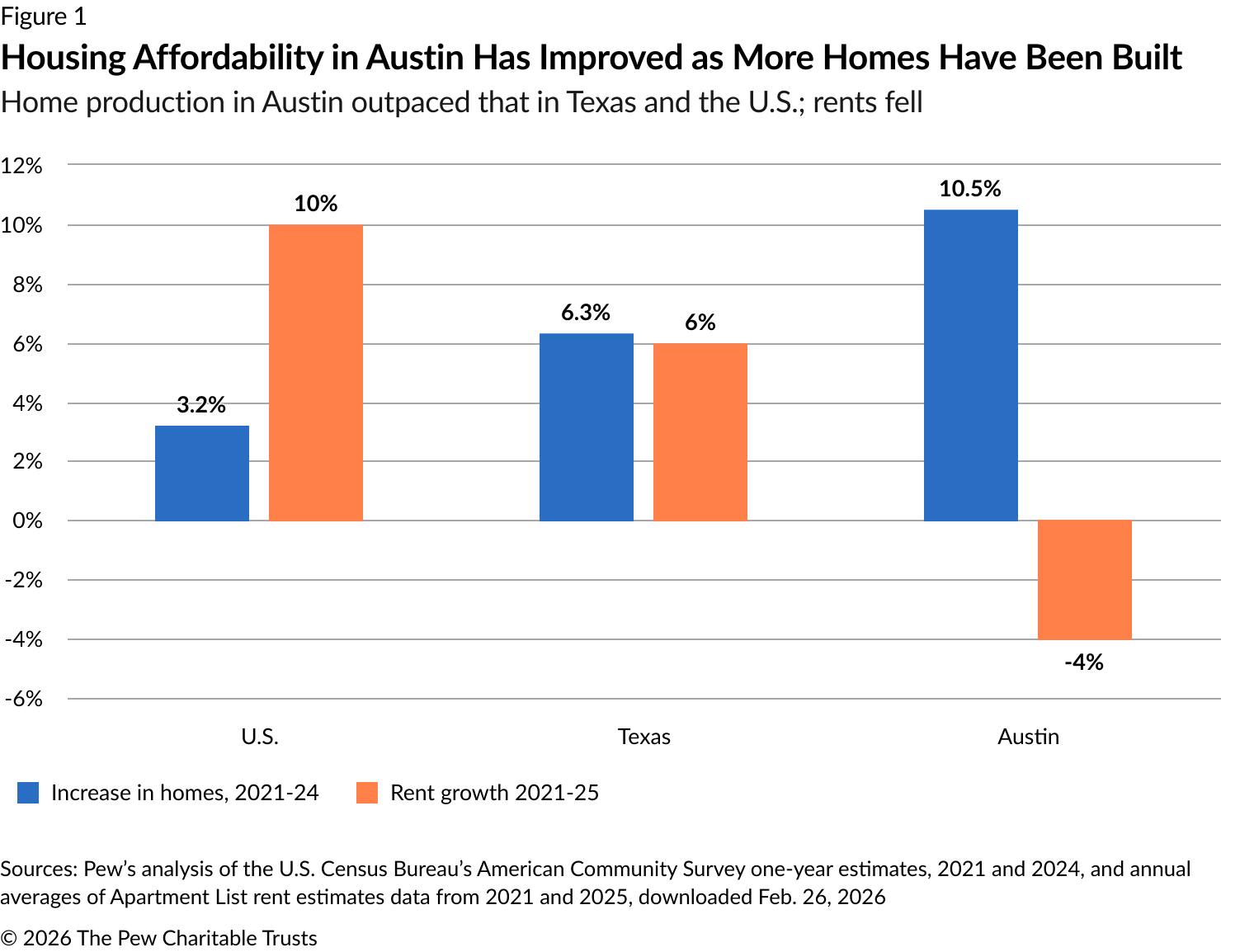
The title of this chart “Housing Affordability in Austin Has Improved as More Homes Have Been Built” is a masterful example of how to lie using statistical implication. There are a number of reasons why this is dishonest:
- “Housing Affordability” here is equated with “relatively lower increase in rents”. Of course, if rents were already unaffordable, then slowing their increase does not “improve housing affordability”.
There are some points here that I want to be absolutely, 100% clear on:
- The YIMBY argument is oversimplified nonsense.
- Charts like the ones presented above provide absolutely no evidence of anything.
- These criticisms also need to apply to analyses that we like the conclusions of.
Time Isn’t Holding Up
The Obvious Error
A clear example, understandable even by a child or (equivalently) a YIMBY-brained adult, is something like: today it rained, and yesterday I decided to buy particularly fancy dog treats. It would, I think, be a bit silly to claim that a my decision to buy Doggue Premium Liver Bites or whatever somehow caused it to rain, because, well,why in the world would that happen?
What this example gets that is that it’s unreasonable to ascribe causal influence (whatever we mean by that) to something simply because it happened before some other thing — after all, everything that has happened happened before everything happening presently. It’s certainly not the case that there’s generally a useful sense in which everything causes everything, at least, not in any of the normal deductive frameworks that people tend to operate in.
Really, what we tend to require is that belief in being a “cause” of , comes with a plausible mechanism by which that could happen. That mechanism could, say, involve a sequence of smaller, less controversial steps that take us from to .
Statistics and Subtlety
This fallacy manifests itself more subtly when engaging in statistical analysis, where it can appear as one of the reasons that “correlation is not causation”.
It’s Worse Than All That
Especially when seeing evidence that supports an agreeable conclusion, it is always tempting to say “well, sure, correlation isn’t causation, but certainly if I see a correlation that provides some evidence that there is a causal relationship”.
Unfortunately, the world of statistics has not conspired to make this so. A correlation between and (some dependent variable and an outcome ) can arise from any of:
- causing
- preventing
- and having a common cause
- causing
- being completely unrelated to
That is: and being correlated provides no evidence of anything by itself - the result is compatible with any possible relationship between and , including that they are just totally unrelated to one-another.
and unrelated
This is an example of “sometimes things just happen at the same time, okay”. You are probably already aware of some of the funnier versions of these, billed as “spurious correlations”.
Here’s a fun example, wherein “Stevie name popularity” is almost perfectly correlated with “Netflix stock price.”
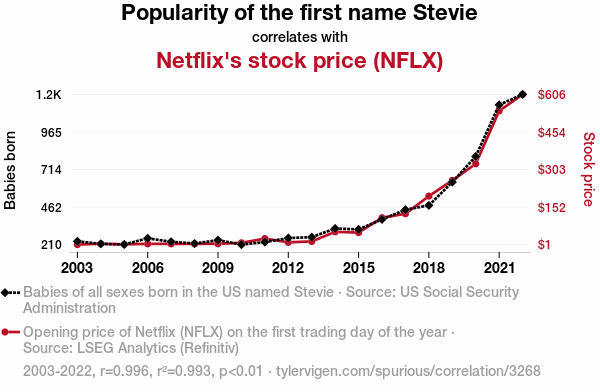
Now, maybe I’m dense, but it seems to me that there’s not any clear, meaningful way in which these two things are related (even with some sort of underlying common variable influencing both of them), they just are increasing coincidentally in the same way.
This is the sort of thing that can “just happen” - especially when there are a lot of variables that you could choose from. Much like someone searching for codes in The Bible, if you stare long enough at enough different things, you can almost guarantee that you will find a pattern that doesn’t really mean anything.
prevents from happening
A historical example of this is related to the use of -blockers1 in patients with heart failure. These are a class of drugs that slow the heart, and one might think that slowing the heart is a bad thing for people whose heart is failing. Naively, this gives a plausible reason why basic outcome statistics reflected that -blockers were associated with worse outcomes for patients.
However, when random studies were ran in the 90s, it was discovered that -blockers actually reduce mortality in patients with heart failure substantially! The reason, ultimately, was that there was a confounding factor: doctors without an experimental protocol tended to give -blockers to patients with more severe health problems - they were more likely to die anyways.
The takeaway here is that could actually actively do the opposite of what summary statistics indicate. This error2 likely caused a great number of preventable deaths in the 20th century.
causing
If things are related in a straightforward causal way, then absent other things going on there should be a correlational relationship between them. Indeed, this is what would be used in an appropriately-designed random experiment to prove causality.
causing
Causality has a direction, while correlational information does not. Yes, a given individual event cannot influence the past, but given that some s and s are spread throughout time, there is an opportunity for a general statement about them to have “reverse causality”.
and have a common cause
So Now What?
Just because the tempting superficial analysis of “line goes up” can lead us astray, that does not mean that all is lost. This is not a call for epistemic nihilism, anti-intellectualism, or “rejection of data”, but rather a call to do science properly.
Footnotes
-
See the AHA for an interesting interview with a cardiologist who pushed for the use of -blockers. ↩
-
This is an example of Simpson’s Paradox. D’oh. ↩